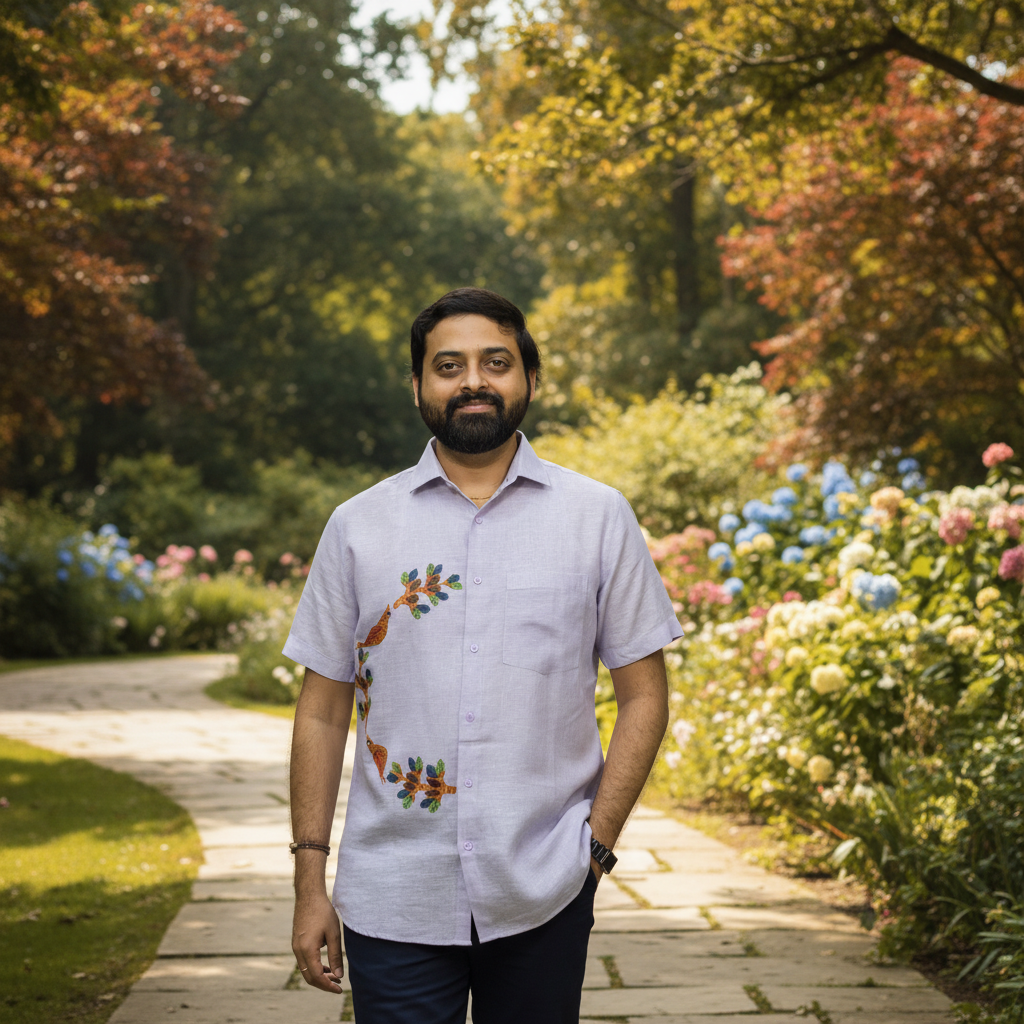
On Indu Sharma, Chamba Rumal Embroidery, and the Responsibility of Visibility
Some crafts do not disappear because they are misunderstood. They remain unseen because few ever get a chance to encounter them.
Chamba Rumal embroidery belongs to this category.
For generations, this form of double-sided narrative embroidery has existed within a narrow circle of visibility—largely confined to its region of origin, to museums, to government-supported exhibitions, and to the attention of a small number of art historians, collectors, and international tourists.
Outside these spaces, awareness has remained limited. Not through disregard, but through lack of access.
Most people in India have simply not had proximity to Chamba Rumal.
Its language has not travelled widely through everyday life. Its discipline has rarely been explained beyond specialist contexts. And its makers, despite extraordinary skill, have often lacked the means to carry the work beyond institutional or seasonal platforms. As a result, understanding of the craft remains restricted—not because it lacks relevance, but because it has lacked sustained visibility.
Within this quiet landscape, practitioners like Mrs. Indu Sharma have continued their work with remarkable resolve.
Her life with Chamba Rumal has unfolded over decades—through practice, teaching, and a steady commitment to keeping the discipline intact. Beyond her own embroidery, she has trained women, passed on technique, and ensured that the grammar of the craft does not thin or fragment with time. This labour is slow and exacting. It allows no shortcuts and offers little immediate recognition.
Keeping Chamba Rumal alive has required more than skill.
It has required patience measured in years.
The responsibility of continuity has often rested disproportionately on artisans themselves. With limited avenues for outreach and promotion, they are expected to preserve traditions quietly while the world outside accelerates. Government initiatives and a few organisations have played an important role in providing recognition and institutional support. But formal acknowledgement alone cannot ensure continuity.
A craft survives fully only when it enters public consciousness.
At The House of Rule Zero, our engagement with Chamba Rumal begins with this understanding. We are not approaching the craft as a yearly initiative or a time-bound project. We practise it daily—through long-term association, careful placement, and patient storytelling. We are not in a rush to extract value from the craft; our intent is to add value to it, slowly and responsibly.
Our role is not to reinterpret Chamba Rumal, modernise its language, or frame it as trend. It is to create space for it to be encountered—closely, quietly, and with context. To allow people to see what makes it distinct: the fact that every stitch must resolve identically on both sides of the fabric, that a single piece can take weeks or months of uninterrupted attention, and that no part of the labour can be concealed or hurried.
This approach is not about making the craft commonplace.
It is about making it visible.
For those who wish to encounter the work more closely, our Chamba Rumal collection offers a small selection shaped through this approach.
By choosing to work with Mrs. Indu Sharma, we choose to share responsibility—so that the effort of keeping Chamba Rumal alive does not rest on her patience alone. Through sustained association, thoughtful circulation, and conversations that move beyond exhibitions and screens, we aim to extend the life of the craft into wider awareness.
This is not a replacement for institutional efforts.
It is a continuation—through proximity rather than display.
Chamba Rumal does not ask to be simplified for recognition.
It asks to be seen.
And once it is seen clearly—its discipline, its time, its lineage—the value reveals itself without insistence.
That is the responsibility we believe must now be shared.