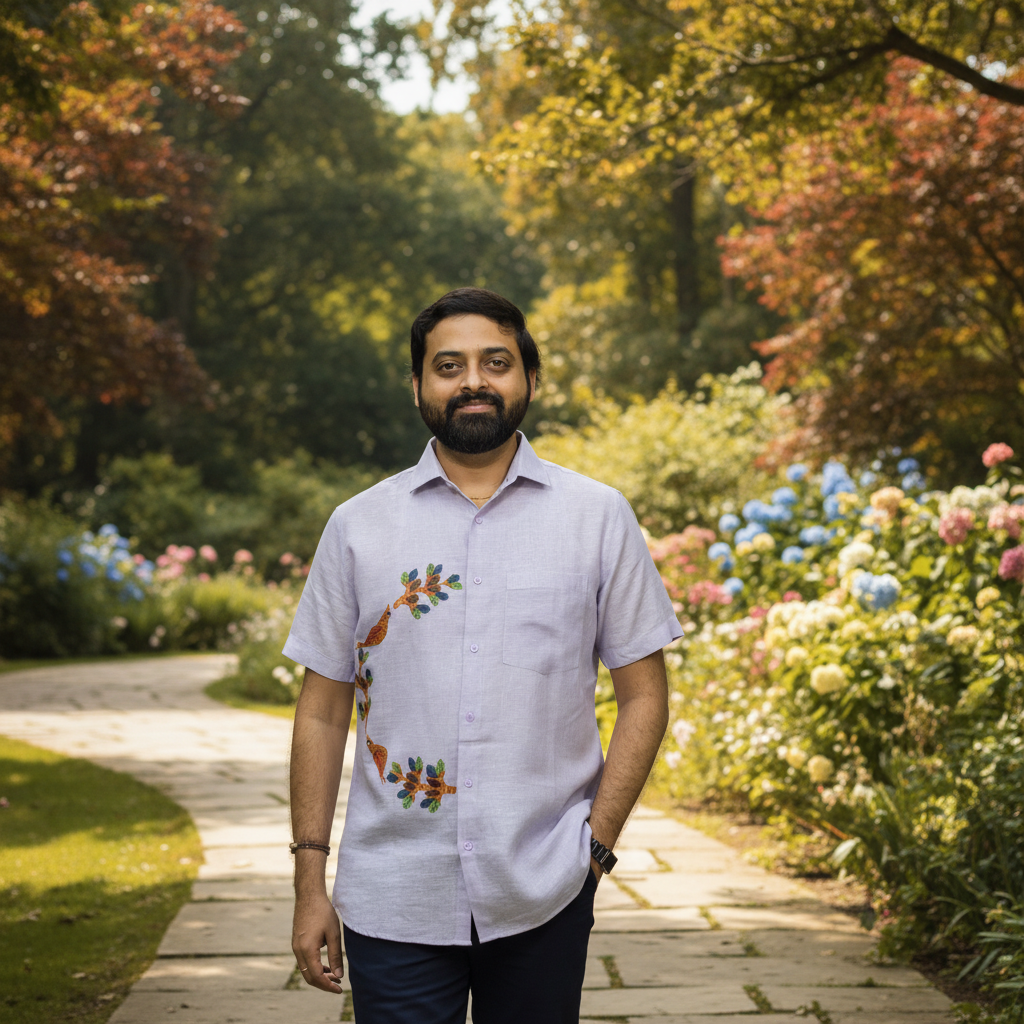
In clothing, much of what matters is invisible.
Fit is felt before it is seen. Comfort reveals itself only after hours of wear. Quality shows up not in the moment of purchase, but in how a garment lives with you over time. For us, getting the stitches right was never a technical decision. It was a philosophical one.
From the beginning, we knew we were not simply making a shirt. We were creating a surface that would carry heritage in its purest form.
Before any artist begins work, the garment itself must earn respect. An artwork cannot live on a careless foundation. Artists respond to balance, proportion, and integrity long before brush meets cloth. The making of the shirt, therefore, had to be considered with the same seriousness as the art that would eventually inhabit it.
At The House of Rule Zero, we chose not to rely on job work.
Instead, we studied proportions, measurements, and movement. We tested sizes repeatedly, refining them until we arrived at a form that felt natural on the body—unforced, balanced, and comfortable. Each shirt is tailor-made, not assembled in parts.
There is a reason for this.
When a single skilled tailor works on a garment from start to finish, something changes. The shirt develops coherence. Seams align with intention. Shoulders sit naturally. The garment holds together not just structurally, but thoughtfully. Stitching becomes judgment, not repetition.
This matters even more because of the materials we work with.
Pure linen, khadi and silk demand patience. Their threads are fragile, their weave responsive. These fabrics do not tolerate speed or rough handling. Stitching them well requires skill, restraint, and time—qualities that cannot exist under rushed or underpaid conditions.
Quality is difficult to achieve through large-scale job work. When labour is undervalued, care becomes impossible. In many factories, garments are produced in overcrowded, poorly ventilated, and unhygienic environments. Anyone who has seen these conditions closely understands that such spaces cannot produce clothing meant to be worn against the skin.
Our choice was deliberate.
We work with experienced, professional tailors—individuals who have spent years perfecting their craft. Many come from families where tailoring knowledge has been passed down across generations. Their work reflects this inheritance: precision without haste, consistency without rigidity.
We produce in limited quantities so that attention is never diluted.
Every element is considered—from collar structure and stitching threads to button spacing and seam tension. The balance between firmness and ease, structure and comfort, is not accidental. It is built stitch by stitch. This care allows the artist to work freely, responding to a garment that already holds integrity.
For us, customer comfort is not a feature. It is a responsibility.
Getting the stitches right is about more than construction. It is about respect—for material, for skill, for the artist’s work, and for the person who will eventually wear the garment. When clothing is made under the right conditions, with the right care, it carries that integrity forward.
Some things cannot be rushed.
Some things should not be outsourced.
And some decisions, once made with clarity, define everything that follows.
This approach shapes every piece in our shirt collection.