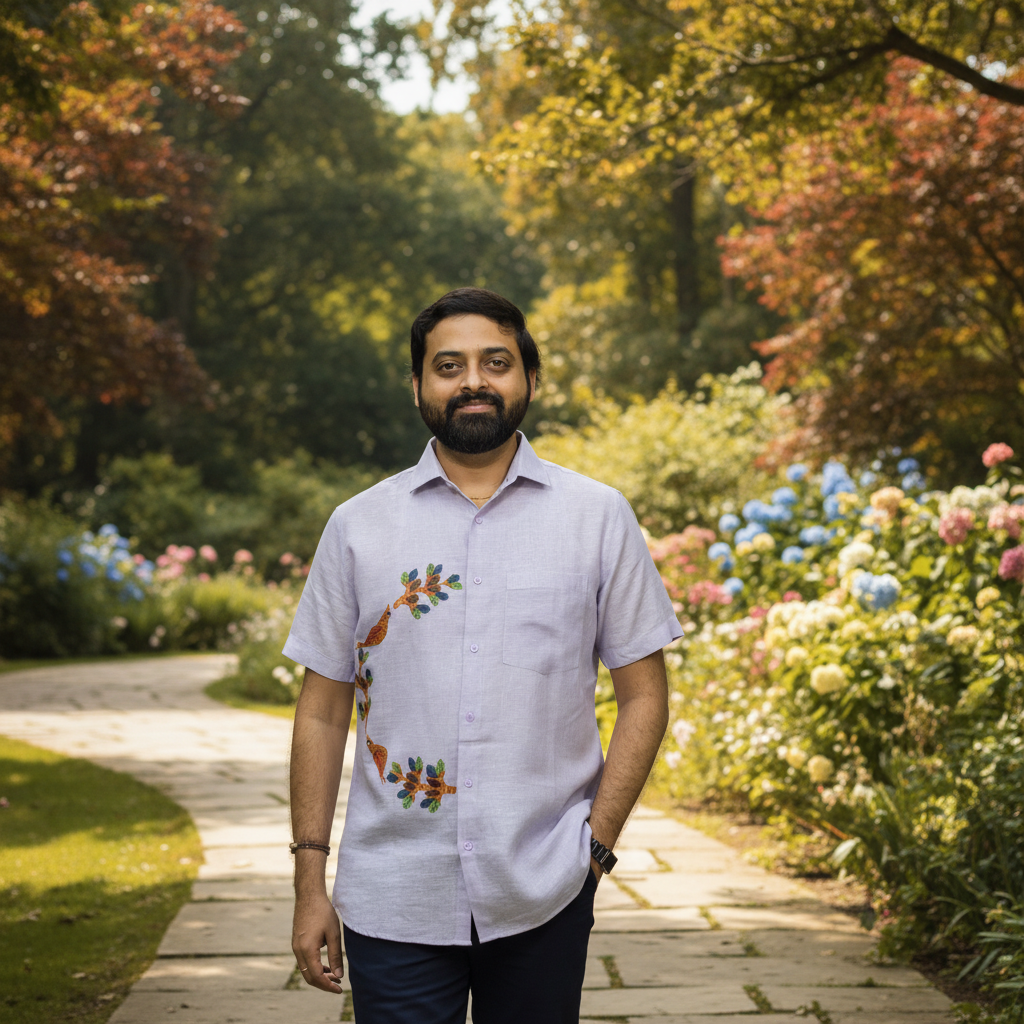
Much of what we wear today is designed to disappear — into routine, into repetition, into the unnoticed margins of daily life. Clothing moves quickly, replaced easily, leaving little behind except accumulation.
At The House of Rule Zero, garments are approached differently. They are created to hold their ground — not as spectacle, and not as excess, but as presence. A piece is not made to fill a wardrobe, but to justify its place within it. Before fabric is cut or colour is applied, each garment begins as a thought shaped by cultural memory, belief systems, and lived experience.
This approach gives rise to clothing with character and meaning, where what is worn carries weight beyond function.
When What Was Worn Reflected How One Lived
Across India’s many regions, clothing was never merely functional. It reflected ways of living, relationships with land, community rhythms, and respect for natural cycles. Art traditions such as Gond, Bhil, Warli, Sujani, Kashmiri Aari, and others documented collective memory, ecological balance, and shared values.
These forms were never created for momentary appeal. They existed to endure — preserving identity rather than responding to passing taste. When such traditions inform contemporary silhouettes, heritage art–inspired clothing does not become nostalgic. It becomes transferable, relevant across cultures and time.
This lineage continues not as revival, but as continuity.
Clothing as an Archive, Not an Inventory
Some wardrobes function like inventories — full, interchangeable, constantly updated. Others function more like archives.
Our creations belong in the latter. They are kept because they carry meaning, not because they align with novelty. They are returned to, not rotated through. Each piece carries authorship — the trace of a hand, a decision, a pause — and therefore resists sameness.
These are garments shaped once, never again in exactly the same way. Their value lies not in replacement, but in relevance that holds over time.
When Wearing Feels Like Alignment
Clothing should never feel like a weight the body must carry. At its best, it feels like alignment — with temperament, mood, and sense of self. When this alignment exists, garments do not demand attention. They support presence.
This is why hand-painted and hand-embroidered garments continue to resonate. Not because they are ornate, but because they carry time, variation, and human judgment. The result is clothing that does not compete for attention, yet remains difficult to overlook.
When what you wear aligns with how you move through the world, even ordinary days carry deliberateness.
Value Without Comparison
Value here is not defined by comparison, affordability, or scale. It emerges from clarity of purpose.
When a garment is created with authorship, it cannot be hurried without consequence. It cannot be endlessly replicated without losing coherence. It does not chase visibility — it holds presence quietly.
This is the difference between clothing that circulates and clothing that stays.
Pieces That Remain
The House of Rule Zero exists for those who prefer resonance over repetition. For those who understand that meaning accumulates through continuity, not volume.
We do not create garments to be cycled through and replaced. We create pieces meant to remain — across moods, moments, and phases of life. When clothing carries meaning, it does not dissolve into routine. It settles into memory, becoming part of how one inhabits the world.
View garments conceived as keepsakes, not commodities.